
Reclusive “Willowman”

The Huffington Post offers an article titled “On The Grounds Of Floriade, The Willowman Lives In His Art” about the reclusive artist of willow:

Tucked into a thick forest amidst the grounds of Floriade, an international horticulture festival held in Holland once every 10 years, is a village of enormous nests and caves made from willow and recycled materials. Inside lives the Willowman.

A bearded recluse inspired by the architecture of nature, the Willowman, whose real name is Will Beckers, works on the village by day, and sleeps inside one of his creations by night.

Beckers’ website describes him as a “Land Artist” who crafts designs with willow branches, and offers workshops on how he does it. “During the project artist Will Beckers lives and works on location in his own installation. He lives in the tree huts he has created as an architect of nature.” The website offers more photos and a brief video.

Huffington Post URL: http://www.huffingtonpost.com/olivia-katrandjian/the-willowman-tucked-amid_b_1626589.html?ncid=edlinkusaolp00000009#slide=1144372
Willowman website: http://www.willowman.com
Alex Soth interview

Alex Soth is an American photographer and filmmake. The theme of his most recent exhibition “Broken Manual” is hermits, mentioned previously in this blog. Soth is currently exhibiting at New York City’s Sean Kelly Gallery. Soth was interviewed by the Blouin ArtInfo website. The article is titled: “How to Run Away: Alec Soth on What He Learned From His New Series of Hermit Portraits,” printed Feb. 17, 2012. Additionally, the mainstream Huffington Post also features Soth in an article titled “Alec Soth’s Photographs Capture Males Outside Of Society” (because the hermits Soth photographed are all men).

Here is an excerpt from the interview, followed by a quoate from the Huffington Post article.

ARTINFO: Hermits aren’t exactly easy to pin down. How did you actually find your subjects?
SOTH: In many cases, I found people on the Internet, which always seems like a contradiction. The whole thing about this project is that it’s a contradiction. One of the resource materials that I looked at a bit… there’s this blog that I read on hermitry. And I just think that’s really funny. All these people reading this blog–
ARTINFO: A blog on hermitry seems like the ultimate irony.
SOTH: Yeah, exactly. …

Huffington Post:

What is the inner life of a hermit like, you ask? There is something unsettling about the men in Soth’s images; they quietly address the interior struggle between savagery and civilization, between masculinity and sensitivity. It is clear that the men place great trust in Soth; the natural urges for both bold masculinity and sensitivity lurk in the shadows of their honest faces. Their haunted, faraway expressions create equally haunting imagery, the wilds of the woods mirroring the recesses of the mind.

URLs:
ARTINFO: http://artinfo.com/news/story/760382/how-to-run-away-alec-soth-on-what-he-learned-from-his-new-series-of-hermit-portraits
HP: http://www.huffingtonpost.com/2012/02/17/alec-soths-hermit-photographs_n_1285167.html

Zuloaga’s “Anchorite”

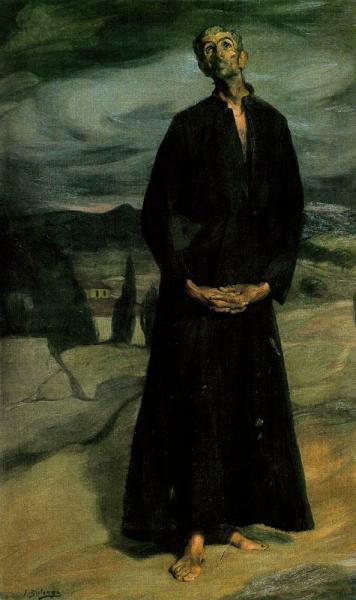
“The Anchorite” of Zuloaga seems entirely 17th century Velasquez, with the elongated human figure, and the whirlwind of sky and dwarfed town like the latter’s famous Toledo. But the artist is Ignacio Zuloaga, who painted it in 1907. Zuloaga did make Velaquez his earliest subject of study. The landscape has become an odd counterpart to the desert, to the world as desert, and though his vestment is conventional, the hermit’s expression is not. The unshaven, barefoot hermit has not a pious but disengaged expression on his face, wistful or mad, the input of centuries of Spanish art, peaking around Goya. The anchorite is not approachable, for he is no longer of this world. In the Musee d’Orsay.

Zuloaga: The Anchorite

Hermit drama

“Next Time I’ll Sing to You” is the title of a play by James Saunders, produced in 1962 and occasionally performed, most recently at the Orange Tree Theatre in Richmond (London). The play has also been staged briefly on Broadway in New York. The play is a “play within a play” with actors/characters waiting for the hermit James Alexander Mason, the “Hermit of Great Canfield, Essex,” to arrive. A summary of the play as found in a recent article in the Richmond Twickenham Times:

The play follows four actors trying to find out the truth about a hermit named James Alexander Mason, who decided in 1906 at the age of 48 to sell his cottage, build a hut in a field beyond his village, surround it with ditches, hives of wild bees, barbed wire and two tonnes of corrugated iron fence to take up solitary residence. His brother left him food every day, but he was not seen again until at the age of 84, when he was brought out dead.

The characters explore a variety of philosophical questions, and moments of Mason’s life and thought are recreated in a non-linear drama that challenges audiences to reflect on meaning, society, and self.

URLs: http://www.richmondandtwickenhamtimes.co.uk/news/9372586.Next_Time_I_ll_Sing_to_You_offers_something_to_think_about/
http://playstosee.com/page.php?sad=play&id=333

Friedrich: “Wanderer in the Fog”

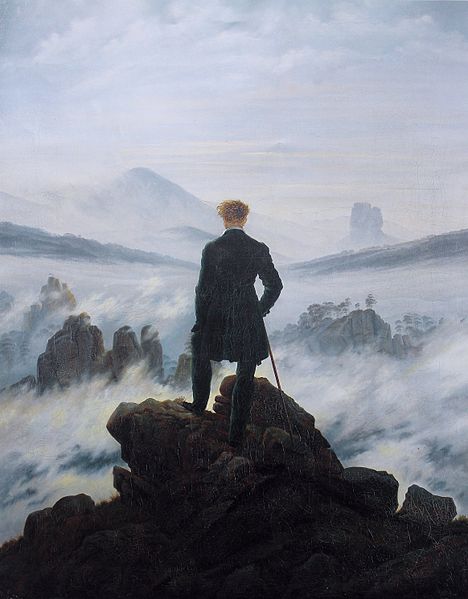
The German Romantic painter Caspar (or Kaspar) David Friedrich (1774-1840) captures the psychological undercurrent of individualism in his “Wander in the Fog” or “Wanderer in the Sea of Fog” (“Wanderer über dem Nebelmeer”), 1817. The painting depicts a well-dressed man standing on a crag, with a spectacular landscape before him. Is he a mere object in the immensity of nature, or does his pose suggest that humanity — or he, at least — has conquered the mysteries of existence and now stands triumphant over the world? Frederich’s other works depicting bleak romantic (even Gothic) settings does not suggest triumph or clarity. But a Nietzschean interpretation is inevitable, as in the cover art of an older English-language translation of Thus Spake Zarathustra published by Wilco in Mumbai, India, in 2006 (which see here).

Wanderer in the Fog

The original is in the Hamburger Kunsthalle.