
“Hermit” of Fukushima

A number of articles about Naoto Matsumura have appeared in the media, variously describing him as loner, solitary, farmer — and this one as “hermit.”

Naoto Matsumura has elected to remain within the 12 mile/20 kilometer exclusion zone around the failed Fukushima nuclear plant to feed and care for animals (cows, dogs, cats, etc.) abandoned by people fleeing the zone.

Surely he understands the health risks, and his motive is never clearly described (he smokes, eats what he admits is bad food, canned). But he is not a martyr or an activist. Matsumura says he does not want to see the abandoned and contaminated towns revitalized — he wants them to disappear.

URL: http://www.terradaily.com/reports/The_hermit_of_Fukushima_staying_put_despite_risks_999.html
Broeder Hugo, Netherlands hermit

Brother (Broeder) Hugo is a Dutch Catholic hermit, born in Drendts, Netherlands, in 1976, a convert. He lives in the vault of an old church in Warfhuizen, in northeastern Netherlands. The church itself is open to the public, attracted by Broeder Hugo’s Marian devotion. His growing popularity is due in part to his embrace of social media (using a web site, Facebook page, and Twitter) for spiritual counseling, his practical advice and recommended readings, and his youthful and friendly manner.

The website (titled “Kluizenarij OLV van de Besloten Tuin” or Hermit of Our Lady’s Enclosed Garden”) is all in Dutch. Includes a video (“Kluizenaar de Film” – “The Hermit on Film”) that follows Broeder Hugo on a typical day.

URL: http://www.beslotentuin.nl/
More info: http://en.wikipedia.org/wiki/Our_Lady_the_Garden_Enclosed

Hermit drama

“Next Time I’ll Sing to You” is the title of a play by James Saunders, produced in 1962 and occasionally performed, most recently at the Orange Tree Theatre in Richmond (London). The play has also been staged briefly on Broadway in New York. The play is a “play within a play” with actors/characters waiting for the hermit James Alexander Mason, the “Hermit of Great Canfield, Essex,” to arrive. A summary of the play as found in a recent article in the Richmond Twickenham Times:

The play follows four actors trying to find out the truth about a hermit named James Alexander Mason, who decided in 1906 at the age of 48 to sell his cottage, build a hut in a field beyond his village, surround it with ditches, hives of wild bees, barbed wire and two tonnes of corrugated iron fence to take up solitary residence. His brother left him food every day, but he was not seen again until at the age of 84, when he was brought out dead.

The characters explore a variety of philosophical questions, and moments of Mason’s life and thought are recreated in a non-linear drama that challenges audiences to reflect on meaning, society, and self.

URLs: http://www.richmondandtwickenhamtimes.co.uk/news/9372586.Next_Time_I_ll_Sing_to_You_offers_something_to_think_about/
http://playstosee.com/page.php?sad=play&id=333

“Hermit of Lost Island,” Bahamas

Article in “Island Notes,” a feature column of Bahamaislandinfo, titled “Sadly Lost to the World: The Hermit of Lost Island,” about the American Trappist monk Gerald Groves.

Groves spent time at the Abbey of Gethsemani and knew Thomas Merton, then spent a little while in Martinique, followed by six years as a hermit in Bahamas beginning in 1960, a period described by the article. Groves lived in an abandoned and dilapidated Baptist Church built in 1902 until development drove him out, returning to the U.S. to study and teach. Groves died in 2003.

(Groves published an article about Merton in a 1979 issue of American Scholar.)

An updated URL (2014): http://www.thebahamasweekly.com/publish/author-historian/Sadly_lost_to_this_world_-_the_hermit_of_lost_beach33846.shtml

URL (no longer available): http://www.bahamaislandsinfo.com/index.php?option=com_content&view=article&id=10087:island-notes-sadly-lost-to-this-world-the-hermit-of-lost-beach&catid=113:island-notes&Itemid=228

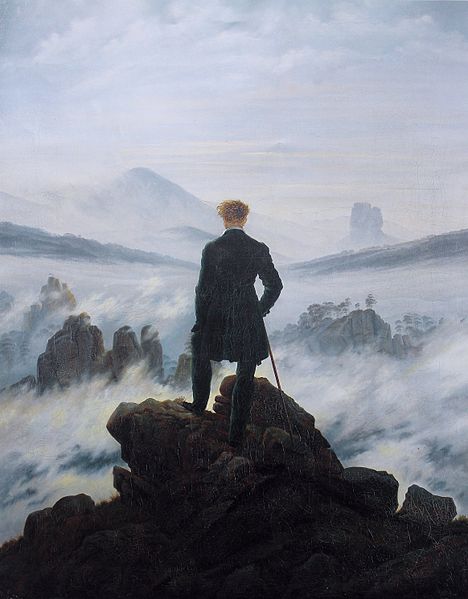
Friedrich: “Wanderer in the Fog”

The German Romantic painter Caspar (or Kaspar) David Friedrich (1774-1840) captures the psychological undercurrent of individualism in his “Wander in the Fog” or “Wanderer in the Sea of Fog” (“Wanderer über dem Nebelmeer”), 1817. The painting depicts a well-dressed man standing on a crag, with a spectacular landscape before him. Is he a mere object in the immensity of nature, or does his pose suggest that humanity — or he, at least — has conquered the mysteries of existence and now stands triumphant over the world? Frederich’s other works depicting bleak romantic (even Gothic) settings does not suggest triumph or clarity. But a Nietzschean interpretation is inevitable, as in the cover art of an older English-language translation of Thus Spake Zarathustra published by Wilco in Mumbai, India, in 2006 (which see here).

Wanderer in the Fog

The original is in the Hamburger Kunsthalle.