
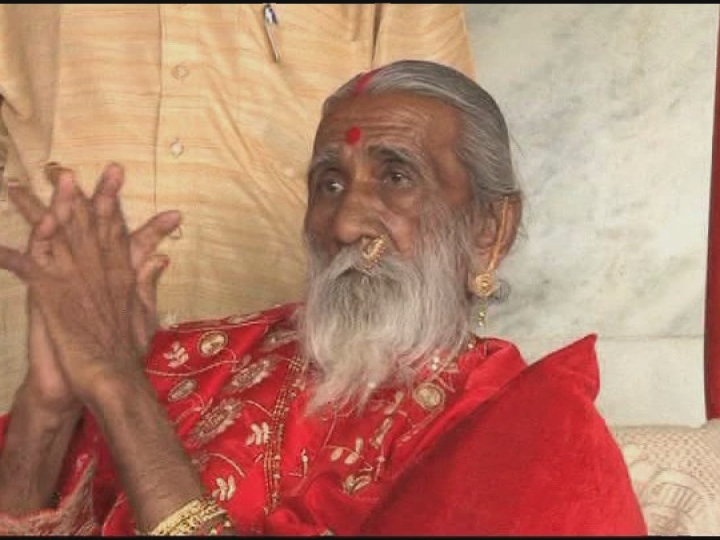
India hermit: no food, water

This is not the first report on Mataji, the India hermit who claims to have not eaten food or drunk liquid almost all of his 82 years of life. This Independent Television News (ITN) item features a 2+ minute video. (The video is also available from the Telegraph TV (UK) filed under “Weird News”; see link below. The text of the article is reprinted here since such items often disappear from the web:

An elderly Indian hermit man has stunned doctors in the western city of Ahmenabad, after claiming he has not eaten of drunk anything for seventy years, and then proved that he can survive without fuel or water for four days.

Prahlad Jani who is known by his followers as Mataji, which means the Mother Goddess, is an 82-year-old.

Medical staff, researchers and scientists from New Delhi-based Defence Institute of Physiology and Allied Sciences of India (DIPAS) carried out an observational study on him after he made his claim, to verify whether it was a hoax.

But, staff are astonished that he has survived even their four day test, let alone seventy years without food and drink.

Neurologist Sudhir Shah of the Sterling hospital where the study was conducted on Jani claimed that his survival and biological processes are miraculous.

He said: “I want to tell you that we are all watching a miracle in the science, or biology so to say, because it is already 108 hours since Mataji’s admission into this hospital and he has not eaten anything; he has not drunk a little drop of any kind of liquid but more importantly, he has not passed a drop of water or stool.

“That makes science a little difficult. A person can live without food and water for three or four days.”

Mataji claims he was blessed by the Hindu goddess Amba when he was just eight.

URL: http://itn.co.uk/a91d4f3a764a424d652db8d5d4b8661d.html
Video URL: http://www.telegraph.co.uk/news/newsvideo/weirdnewsvideo/7764884/Indian-hermit-stuns-doctors-by-surviving-without-food.html

Idaho hermit

Idaho hermit Richard Zimmerman, called “Dugout Dick,” recently passed away at 94. He is described in this article from the Idaho Statesman.

Zimmerman was one of a number of Idaho loners, and perhaps the last. He was entirely self-sufficient, living in a series of caves, growing fruits and vegetables, and maintaining a root cellar. Placed in an elderly care center recently by an acquaintance, he left of his own accord and hitchhiked back to his caves.

Article: http://www.idahostatesman.com/2010/04/23/1164899/death-of-caveman-ends-an-era-in.html
Video:
http://www.imdb.com/video/wab/vi3045786649/ – link brought to our attention by a friend of Hermitary
Another video, from NBC News (local?) circa mid-1980’s: http://www.youtube.com/watch?v=KD53LVjXIHs

NYT on solitude

This New York Times article titled “Embracing a Life of Solitude” is placed in the Home & Garden section because it sees solitude as escape, “downtime,” as one interviewee puts it, or plain “fantasy.” Usually this escape is to a more natural setting, as in the examples in the article, which emphasize discomfort and survivalism. The tone of the piece may be further gathered from the egregious notice of the French roast coffee drunk by one “escapee” and the sexual qualms of another who felt that solitude deprived him of meeting members of the opposite sex.

URL: http://www.nytimes.com/2010/04/15/garden/15alone.html?pagewanted=1&ref=garden

Hermit tortoises

“Hermit” tortoises, in this case the red-footed tortoise, learn by imitating other tortoises. The experimenters conclude that social learning is based on cognitive ability, not an evolved specialized learning skill. The red-footed tortoise grows up without parents or siblings, and shuns others of its species. Cognitive learning, in the case of this experiment, consisted of a puzzle to solve for attaining a treat — which does not work with human hermits!

URL: http://blogs.discovermagazine.com/80beats/2010/03/31/even-antisocial-tortoise-hermits-learn-from-each-other/

Mabifi, Botswana hermit

A poignant piece from Botswana titled “The Hermit of Mogoditshane” reflects the poverty of the region as part of the context of the hermit’s own situation. Here is the byline:

The little tin shack has stood in its present location for nearly 30 years. The figure that has been seen going in and out of the little hole that forms the doorway, and sometimes disappearing for days on end is Moagisi Mabifi.

The journalist sympathizes with his interviewee, the latter recalling his life’s circumstances and how he came to find himself living as a hermit. The narrative offers the sense of irony and what the journalist calls Mabifi’s sense of “hopelessness.”

URL: http://www.mmegi.bw/index.php?sid=6&aid=519&dir=2010/March/Monday1